
From the Voice of a Resilience Expert: Dr. Taryn Marie Stejskal on Love, Loss, and Living Like Knoxy
Some conversations stay with you long after they end. Our recent talk with Dr. Taryn Marie Stejskal was one of them.
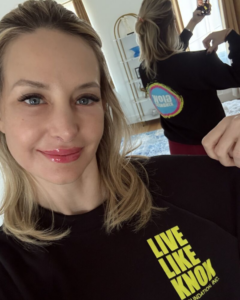 Dr. Taryn Marie is the Founder and CEO of The Resilience Leadership Institute and the author of the #1 Wall Street Journal bestseller The Five Practices of Highly Resilient People: Why Some Flourish When Others Fold. For more than a decade she has interviewed hundreds of people about the most defining and difficult moments of their lives, asking a single question underneath all the others: why do some people flourish when others fold? When we shared Knoxy’s story with her, she met it not with easy comfort but with something far more useful, a clear-eyed understanding of what helps people carry love forward through loss.
We are honored to share her reflections with our community this week, in her own words.
When you first heard Knoxy’s story and learned about the mission, what stood out most?
What stood out to me immediately was not just the depth of loss, but the depth of love that continues to live on through that loss. As someone who has spent the last decade deeply immersed in the science and human experience of resilience, interviewing hundreds of people about the most defining and difficult moments of their lives, I have come to understand that what separates those who flourish from those who fold is rarely about the nature of the adversity itself. The difference lies in what we do in the presence of that adversity, and what we choose to carry forward.
So often, tragedy silences people. But what I understood in Knoxy’s story, and in the mission of this foundation, is the opposite. Behind the mission and vision of the foundation is love being expressed louder, more intentionally, and more generously in response to something unimaginable. That is both remarkable and rare.
For me, encountering Knoxy and his family’s story is resilience in its most powerful form: not moving on, but choosing, with profound intentionality, how you move forward and what you carry with you as you do.
After spending time with Kim and hearing their journey, what stayed with you?
What stayed with me was the quiet strength, the kind that doesn’t announce itself and doesn’t need to.
Not performative strength. Not the “everything is okay” strength that we so often use as a shield when the world feels like too much. But the kind of strength that coexists with heartbreak, that sits side by side with grief without demanding that one of them leave. This is the strength of continuing to love, to show up, to create meaning, even amidst the magnitude of Knoxy’s loss and his absence from daily life.
In my research, I have found that this kind of strength doesn’t come from willpower alone. Resilience of this depth comes from something far deeper: from the quality of our connections, from the clarity of our purpose, and from the decision, made again and again in quiet moments, to keep a spirit alive even when the person is no longer physically present. That is what I saw in Kim, and what I will carry with me.
What does real resilience look like in families navigating profound loss?
I believe that resilience in these moments is an ever-present paradox, and that navigating it with honesty and candor is itself an act of extraordinary courage.
Real resilience in families looks like holding two seemingly contradictory truths at the same time. It looks like families who can grieve and love simultaneously, who can hold space for remembering and for laughing, even when the laughter comes through tears. It looks like allowing room for anger, for sadness, for the kind of bone-deep exhaustion that grief brings, and also for unexpected moments of peace.
What resilience in loss is not, and this is something I feel strongly about from both my research and my own lived experience, is the pressure to “get back to who you were.” You cannot go back. You were changed the moment the loss occurred. The real work of resilience is learning how to carry what you’ve lost alongside the journey of who you are still becoming, and discovering that both things can be true at once.
How is resilience different in grief versus professional adversity?
In professional adversity, we are often navigating problems that are, at their core, solvable. A failed product launch, a difficult team dynamic, a career pivot that didn’t unfold as planned. These moments can feel enormous while we are inside them, and they are real losses. But there is usually a next step, a strategy, a way to regroup and move forward. We are, in those moments, still holding the wheel.
What makes grief so all-encompassing is that there is no strategy capable of undoing what creates it. Our actions, our will, our best and most carefully constructed plans cannot reverse the loss of someone we deeply love. That is the fundamental difference, and it is significant.
Grief requires a different kind of resilience than professional adversity, one rooted in acceptance, in emotional capacity, and in meaning-making, rather than in control or optimization. You don’t “overcome” grief. You learn how to live alongside it. Over time, grief shapes you in ways you could not have anticipated, often in ways that ultimately deepen your humanity.
What do you want families to know about the non-linear nature of healing?
I want families to know, first and foremost, that healing is not a straight line. Healing is not a ladder whose top you eventually reach. In my experience, both personally and professionally, healing moves more like a spiral. You revisit the same emotions, the same grief, the same love, but each time you do, you are doing so from a slightly different place. You have more context, more distance, more of yourself available as you navigate the terrain.
There will be days that feel as heavy as the earliest days. A song, a season, an ordinary Tuesday that arrives carrying more weight than you expected. And I want families to know that a hard day does not erase a single step of the progress they have made. A hard day is not evidence of failure. That kind of day is evidence that love is still present, still pulsing, still real, and something worthy of being honored rather than feared.
How important is meaning-making after tragedy?
In my research, meaning-making is one of the most consistently powerful predictors of resilience. It is not about minimizing what happened or manufacturing a silver lining where one doesn’t exist. It is about the very human need to locate a sense of purpose within the experience of pain.
We cannot always control what happens to us, but we do have the capacity to shape what our experiences become. I have interviewed hundreds of people who have navigated extraordinary loss and adversity, and the families who are able to find meaning, whether through honoring a loved one, through serving others, or through building something in a person’s name, consistently experience a different quality of resilience. Not because the pain is less, but because the pain is now connected to something larger than the pain itself.
Knoxy’s story is a living example of this. His family has taken an unimaginable loss and transformed it into a movement built on kindness. That is meaning-making at its most courageous.
What do children teach us about resilience?
Children are among the greatest teachers of resilience I have ever encountered, and I say that with the full weight of my research behind it. They remind us that resilience is not, at its core, about toughness. Toughness was never the foundation of resilience. Openness always has been.
Children feel fully. They love without reservation. They forgive with a speed that astonishes adults. They stay connected to joy even in the smallest of moments, a ladybug on a leaf, the smell of rain, the satisfaction of a good jump in a puddle. They experience the world with a porousness that most adults have learned, often quite deliberately, to shut down.
As adults, we have a tendency to believe that resilience means shutting down emotion, that the goal is to feel less so that we are hurt less. Children are a constant, living reminder that the opposite is true. Resilience is built by staying open to feeling, not by armoring against it.
How does kindness strengthen resilience?
Kindness strengthens resilience because it builds the one thing that sits at the very foundation of our capacity to withstand hardship: connection.
I have studied resilience across hundreds of conversations with some of the most extraordinary people I have ever encountered, and one of the clearest and most consistent findings is that human beings are not meant to navigate difficulty alone. Connection is not a nice-to-have when life gets hard; it is essential, the very architecture of resilience.
Kindness is one of the most direct pathways to connection. For the person receiving it, kindness reduces the sense of isolation that makes hard times feel unbearable. For the person offering it, kindness creates meaning and a sense of agency, the knowledge that even in circumstances where we cannot fix what is broken, we can still do something. And in both cases, kindness carries the same quiet, powerful message: you are not alone.
Why do small acts matter so much?
Because resilience is built in moments, not milestones.
We tend to look for the grand gestures and the sweeping interventions, and while those have their place, the real architecture of resilience is constructed out of something far more ordinary. A text that arrives on a hard day. A smile from a stranger who somehow understood that you needed one. A small gesture of care that costs almost nothing and yet lands like a lifeline.
These moments accumulate in ways we rarely see in real time. Over weeks and months, they create something essential: a sense of safety, of belonging, of being seen and supported, that becomes the foundation people draw from when life becomes most difficult. Small acts are not small; they are the very building blocks of resilience.
What would you say to someone who feels too depleted to be kind?
I would say: start smaller than you think you need to, and begin with yourself.
Kindness doesn’t have to be outward-facing first. It can begin much closer to home, with giving yourself permission to rest, to feel exactly what you are feeling, to release the expectation that you should have everything together. Self-kindness is not self-indulgence; it is the very beginning of having anything left to give.
There is a reason we are instructed on airplanes to secure our own oxygen mask before assisting others, and that same logic applies here with equal urgency. You cannot pour from a vessel that has run dry, but you can begin, gently and without judgment, the work of filling it back up. That is not a small thing; that first act of kindness belongs entirely to you.
What happens when kindness becomes collective?
Collective kindness becomes culture, and that is when something genuinely transformative occurs.
When kindness is practiced collectively, woven into the expectations and rhythms of how a community shows up for itself, resilience is no longer an individual burden that each person must carry alone. Resilience becomes a shared experience, something held by the group and available to every individual within it. That is the difference between resilience as a survival skill and resilience as a way of living. And the Live Like Knox Foundation is one of the most vivid examples I have seen of a community choosing to build exactly that.
What is your message to the LLK community?
What you are doing matters in ways that extend far beyond what you can currently see or measure.
Every act of kindness, every moment of choosing to show up for someone in need, creates effects that ripple outward in directions and at distances we can rarely anticipate. The research on this is clear, and so is my own experience: kindness compounds. Connection compounds. The decision to keep showing up, especially in a world that sometimes makes that feel impossibly hard, compounds.
You are not simply honoring Knoxy. You are actively shaping the way people experience life, loss, and the possibility of connection. You are building something that will outlast any single act of generosity. That is a profound and beautiful thing, and it deserves to be named.
If there were one message from Knoxy’s story about resilience, what would it be?
That love does not end. Love transforms.
This is perhaps the most important thing I have come to understand through both my research and my own life: the relationships that matter to us do not conclude with loss. They change form. They become the values we carry forward, the kindness we practice in someone’s name, the courage we locate in moments when we might otherwise give in to despair.
When we choose to carry love forward, when we make love active and generative and outward-facing in the way this foundation does every single day, we create something meaningful out of even the hardest moments. We prove that love, expressed through purpose and practice, is more enduring than loss.
With heartfelt thanks to Dr. Taryn Marie Stejskal of The Resilience Leadership Institute for sharing her time and wisdom. Learn more about her work and The Five Practices of Highly Resilient People at www.resilience-leadership.com.
Carry on kindness, just like Knoxy did. Take the Kindness Pledge, nominate an #LLKD Kid, or donate to support character-based scholarships at livelikeknox.com. Kindness carries on.
Want to be part of carrying on Knoxy’s kindness? Take the Kindness Pledge, nominate a student, or make a donation at livelikeknox.com.
